On this pageContents
- The short answer
- The capability ladder: what each tier actually does
- Tier 1: toy and RC robot dogs (about $36 to $100)
- Tier 2: programmable kits (about $124 to $649)
- Tier 3: consumer quadrupeds (from $1,600)
- Age ratings, small parts and button batteries: what the rules say
- What each tier can't do
- Which tier suits whom?
- Buying in the US or Australia
- From our store
- Frequently asked questions
- How we checked
Last checked: 23 October 2026. Prices and stock change often; each one below is the maker's own store price on that date.
How we made this page: this is a spec-sheet comparison. Every capability below comes from the maker's product page, manual, spec table or official code repository, and every rule from the regulator's own page. We haven't used these robots ourselves. Where a maker doesn't publish something (an age rating, a battery spec, a weight), we say so instead of guessing.
The short answer
The three tiers differ less in price than in what "programmable" means.
- A toy or RC robot dog (about $36 to $100) plays tricks from a remote, touch or voice. Its "programming" is picking built-in moves and playing them back in order. That's how Contixo's manual describes it 124.
- A programmable kit (about $124 to $649) is a small robot you build and code. Options run from block code on an ESP32 board to Python on a Raspberry Pi to ROS 2 7131419. The catch: short walks and light loads. Petoi's Bittle X walks about an hour per charge and carries 1 lb 9.
- A consumer quadruped (from $1,600) such as the Unitree Go2 is a 15 kg machine with lidar on every version 2224. But Unitree's own table lists secondary development only on the X (partial) and the EDU 25.
For prices tier by tier, including the costs a list price leaves out, see How much does a robot dog cost?. This page is about what each tier does, and who it suits.
The capability ladder: what each tier actually does
From published specs only. Starting prices are the maker's own store price on the "Last checked" date above, in US dollars, before shipping and import charges.
Toys and kits
Quadruped
Maker-store prices on 23 Oct 2026, before shipping and import charges. Two scales: compare bars within a panel. The Ruko price was a sale price 3; Go2 EDU is by quote 22.
| Example (maker) | From | How you control it | What "programming" means | What you must add | Maker's age rating | Evidence | |
|---|---|---|---|---|---|---|---|
| Toy / RC | Contixo R3 | $35.99 1 | Remote, touch, voice commands 12 | Pick built-in actions, play them back in sequence 2 | Takes 4 AA (dog) and 2 AAA (remote); the page doesn't say if they're included 2 | Ages 3–8 1 | Supplier-stated |
| Toy / RC | Ruko R1 Mini | $49.99 on sale 3 | Remote and gesture sensing 3 | "Programming Up to 10+ Actions" 3 | Not stated on the page 3 | Not stated on the page 3 | Supplier-stated |
| Toy / RC | Sharper Image Ai Dog Robot | $99.99 4 | Voice, touch and remote 4 | Not described 4 | 2 AAA batteries (not included) 4 | Not stated in the product listing 4 | Supplier-stated |
| Kit (ESP32) | Freenove Robot Dog Kit for ESP32 | $123.99 14 | App (Android, iOS) or computer 14 | Code from the maker's tutorial 14 | 2 × 18650 cells and a charger 14 | Not stated 13 | Supplier-stated |
| Kit (Raspberry Pi) | Freenove Robot Dog Kit for Raspberry Pi | $129.99 13 | App or computer 13 | Python 13 | A Raspberry Pi, 2 × 18650 cells, a charger 13 | Not stated 13 | Supplier-stated |
| Kit (Raspberry Pi) | SunFounder PiDog | $179.99 16 | App, voice and vision features 16 | Python 16 | A Raspberry Pi (5, 4, 3B+ or Zero 2 W) 16 | Not stated 16 | Supplier-stated |
| Kit (ESP32) | Petoi Bittle X V2 | $319 5 | App or voice, 35+ commands 8 | Block code, Python, C++ 7 | A USB charger (cable included) 9 | 10+; younger with adult supervision 6 | Supplier-stated |
| Kit (ROS 2) | MangDang Mini Pupper 2 | $604 19 | Wi-Fi web controller recommended; controller not included 19 | Python, ROS 2 19 | Lidar for SLAM and navigation; camera for vision 1920 | Not stated 19 | Supplier-stated |
| Quadruped | Unitree Go2 Air / Pro / X / EDU | $1,600; EDU by quote 22 | App; controller optional on Air and Pro 2224 | Graphical programming on all; secondary development X (partial) and EDU only 2425 | Nothing to build; shipping, duties and taxes extra 23 | No age rating on the page 28 | Supplier-stated |
Reading the table:
- "Programmable" on a toy box isn't the same as on a kit. Contixo's manual has you press action buttons, then press "programming" again to play them back in order 2. A kit runs code you write. Bittle X's board is an ESP32, and Petoi publishes its framework as open source under the MIT license 711.
- The cheapest kits aren't complete. Both Freenove kits need two 18650 cells and a charger, and the Raspberry Pi version needs a Raspberry Pi too 1314. SunFounder's PiDog also ships without a Raspberry Pi 16.
- Most kit pages give no age rating. Of the kits here, only Petoi states one: 10 and up 6.
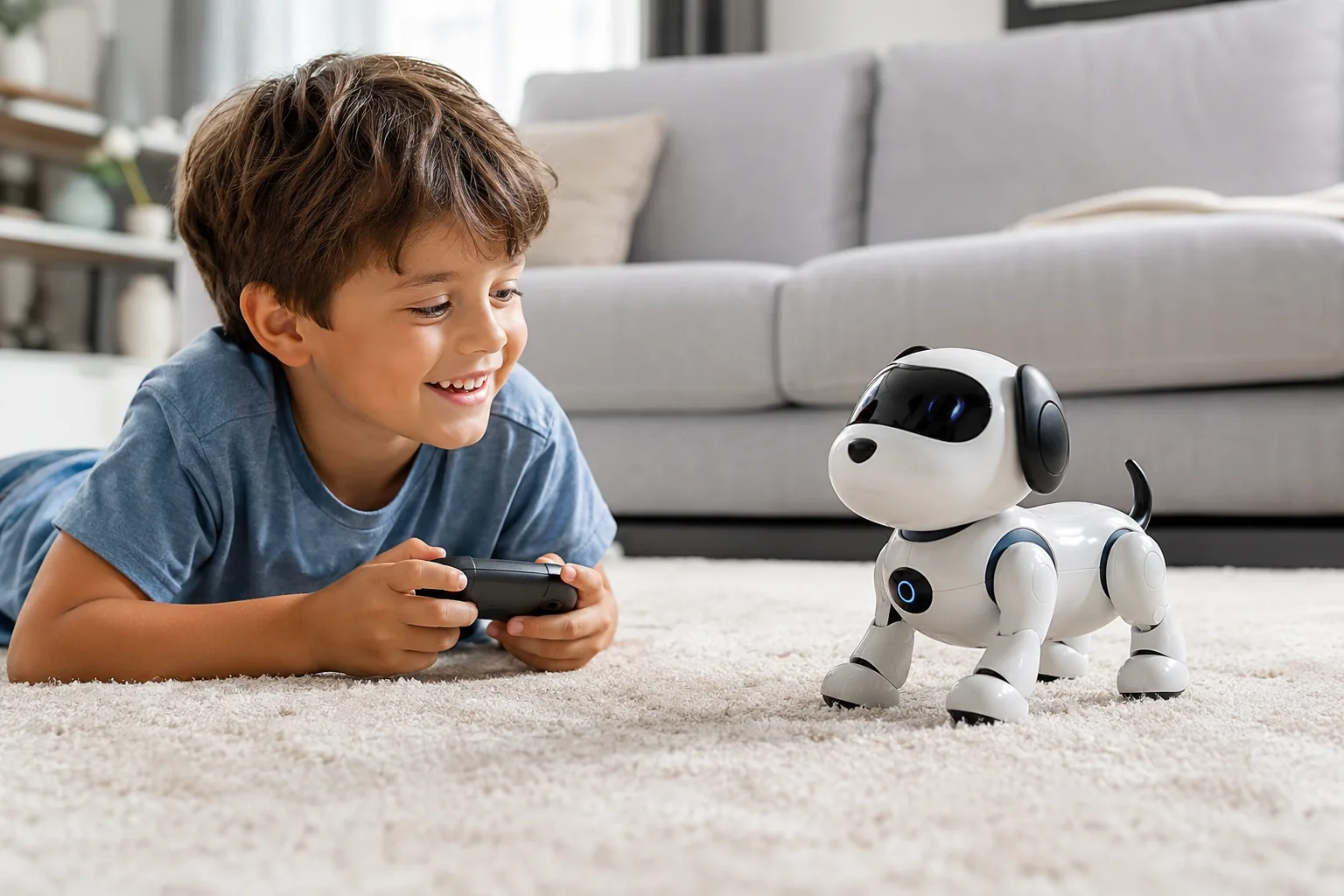
Tier 1: toy and RC robot dogs (about $36 to $100)
A toy robot dog is built for play and reacts to you. The makers list tricks, sounds, lights, remote control, and touch, gesture or voice commands 134.
What that looks like in practice, from Contixo's manual for the R3:
- Voice and touch: it answers spoken commands such as "Sit Down", "Handstand" and "Push-ups", and you touch its mouth to interact 2.
- "Programming mode": you select action buttons on the remote, then press the program button again to play the selected actions in sequence 2.
- Power: 4 AA batteries in the dog and 2 AAA in the remote 2. It sleeps after 80 seconds without input 2.
Ruko's R1 Mini adds gesture sensing and lists "Programming Up to 10+ Actions" and up to 50 minutes of play 3. Its page doesn't state an age range or battery details 3.
Who it suits: a younger child who wants a dog that dances and responds. Check the maker's age rating on the box. Contixo rates the R3 for ages 3–8 1. If the goal is learning to code, the next tier is the one that does it.
Tier 2: programmable kits (about $124 to $649)
A kit is a real legged robot at small scale: you build it, then write the code that moves it. The five kits we read, from four makers, split by what you program them with.
ESP32 kits: Petoi Bittle X and Freenove ESP32
The only part Petoi's FAQ says you add to Bittle X is a USB charger 9. Its BiBoard V1 is an ESP32 board, and it has 9 joints (2 per leg plus the neck), a gyroscope and a back touch sensor 7. You can code it in block code (Petoi Coding Blocks), Python or C++ 7. It takes 35+ voice commands, and you can program up to 10 of your own 8. Petoi says it processes voice locally and needs no network connection 8.
The limits come straight from Petoi's pages:
- About one hour of continuous walking per charge 9. Petoi's battery guide says running can drain it in under 30 minutes, while coding and testing postures lasts "a couple of hours" 10.
- A 1 lb payload, and it isn't waterproof 9.
- No charger in the box, only a Micro-USB cable 9. Petoi's battery guide says the battery should be charged under adult supervision, and that with a charger meant for children, only people at least eight years old should charge it 10.
- Assembly: 40–90 minutes for the construction package, including setup 9.
Freenove's ESP32 kit costs $123.99 and uses an ESP32-WROVER with an ESP32-CAM camera 14. You supply two 18650 cells and a charger 14.
Raspberry Pi kits: Freenove and SunFounder PiDog
A Raspberry Pi kit trades a ready board for a full Linux computer you add yourself. That means Python and camera projects, but more parts to buy and set up.
- Freenove Robot Dog Kit for Raspberry Pi ($129.99): Python code, face recognition and ball tracking listed in the title, app control on Android or iOS 13. You add the Raspberry Pi, two 18650 cells and a charger 13. The tutorial is a download; there's no paper copy 13.
- SunFounder PiDog ($179.99): 12 metal-gear servos, a camera for color recognition and face detection, an ultrasonic sensor, touch sensors, a sound-direction sensor and a 6-DOF IMU 1617. Its AI features name online models such as ChatGPT and Gemini as well as local models through Ollama 16. SunFounder's code is published under GPL-2.0 18.
One version trap: SunFounder's documentation says the Standard PiDog's servos and Robot HAT are not compatible with Raspberry Pi 5; the V2 adds Pi 5 support 17. Check which version you're buying before you pick a Pi.
ROS 2 kits: Mini Pupper 2
Mini Pupper 2 is the step toward research-style robotics. MangDang lists ROS 2 for simulation, SLAM and navigation, with Python 19. Its ROS code is published under Apache-2.0 21.
Two parts aren't in the default box. MangDang says SLAM and navigation need a lidar module, and it only guarantees the STL-06P lidar with its official code 1920. The camera module is also left out "for potential security issues" 19. The legs-pre-assembled kit is $604 and the fully pre-assembled kit $649 19.
Who this tier suits: a learner who wants to write code that makes something walk. Bittle X fits a 10-and-up learner by Petoi's rating 6. The Pi kits suit builders comfortable with Linux, Python and buying a few extra parts; neither maker states an age rating 1316. Mini Pupper 2 suits students heading for ROS 19.
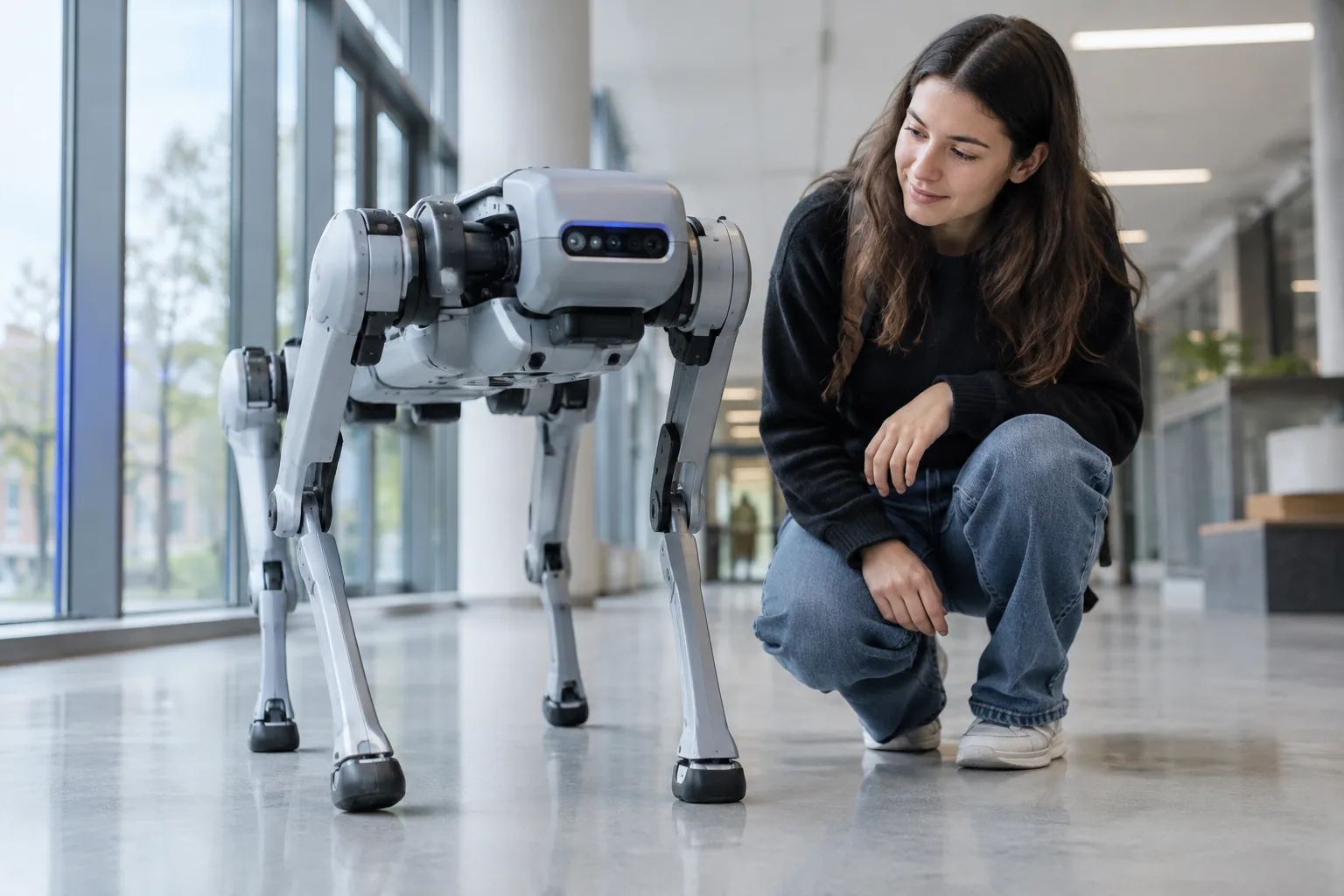
Tier 3: consumer quadrupeds (from $1,600)
A Unitree Go2 is a different class of machine, not a bigger kit. Every version weighs about 15 kg (about 33 lb), stands 70 × 31 × 40 cm, and carries a 4D lidar and an HD wide-angle camera 24. It runs at up to 2.5 m/s on the Air and 3.5 m/s on the Pro, carries about 7–8 kg and steps up about 15–16 cm 26.
What changes the decision between versions, from Unitree's spec table:
- Programming: graphical programming is listed on all versions 24. Secondary development, meaning writing your own software for the robot, is marked only on the X (partial) and the EDU 25.
- Research hardware: a depth camera, foot-end force sensors and an optional high-computing-power module are EDU-only 27. The EDU price is by quote 22.
- Runtime: about 1–2 hours on the standard 8000mAh battery; the EDU's 15000mAh battery gives about 2–4 hours 26.
- Warranty: 6 months on the Air, 12 months on the other versions 26.
- 4G: voice and 4G with GPS start at the Pro 27. But Unitree's footnote says the 4G function outside mainland China "will only support 43 European countries (except Ukraine), and some Asian regions" 28. Unitree doesn't list the US or Australia there, or name which Asian regions are covered.
Unitree also says some functions need "human operation or secondary development", and calls the Go2 "a civilian robot" 28. On its own store, shipping runs $399 to $1,000, and the customer handles customs duties, taxes and clearance 23.
Who it suits: a creator, demo team or hobbyist who wants a full-size quadruped (Air or Pro), or a lab that needs to program one (X or EDU) 2527. The full version-by-version comparison is in our Go2 Air vs Pro vs EDU guide.
Age ratings, small parts and button batteries: what the rules say
The age on a robot dog's box is the maker's rating, not a safety guarantee. Here's what the makers say and what the regulators require. For the full explainer, see Kid-safe robot kits.
What the makers rate them for:
- Contixo R3: ages 3–8 1.
- Petoi Bittle X: 10 and up; younger users can build it under adult supervision 6.
- Ruko R1 Mini, Freenove, SunFounder PiDog, Mini Pupper 2 and the Unitree Go2: we found no age rating on the pages we read 313161928.
US: CPSC small-parts rules. The CPSC bans small parts in products intended for children under three 31. Toys and games that are or contain a small part must carry a warning not to buy them for children of certain ages 31. For toys with small parts intended for children at least 3 but under 6, the label reads: "WARNING: CHOKING HAZARD – Small parts. Not for children under 3 yrs." 32 When the CPSC judges whether a product is intended for children under three, one factor is the manufacturer's stated intent, such as the age on the label 31.
Australia: mandatory button/coin battery standard. Since 22 June 2022, consumer goods containing button or coin batteries, including toys and accessories such as remote controls, must meet a mandatory safety standard 33. If the battery is user-replaceable, the compartment must resist being opened by young children, and screws should be captive 33. Product Safety Australia defines these batteries as flat, round single cells wider than they are tall, and says lithium ones pose the highest risk 34.
Where that touches the robots here: Petoi's battery guide says its infrared remote, used with older Petoi kits, takes a CR2025 coin battery and carries a swallowing warning; Petoi says that remote doesn't work with the Bittle X V2 10. Contixo's R3 uses AA and AAA batteries 2. Freenove's kits run on two 18650 cells you buy separately 1314. We haven't checked any product here against the Australian standard or the CPSC rules. Check the packaging and the seller's compliance statement for the exact item you buy.
What each tier can't do
Each tier stops somewhere. Check the line before you buy.
Makers' published figures. Ranges are drawn at their upper end. Bittle X can drain in under 30 minutes when running 10.
- The toys here don't run code you write. Contixo's "programming" is a sequence of built-in moves 2, and Ruko lists "Programming Up to 10+ Actions" without describing code 3. Most toy pages publish no runtime, sensor or age data to compare 34.
- Kits can't walk long or carry much. Bittle X walks about an hour and carries 1 lb, and it isn't waterproof 9.
- The cheapest kits can't run out of the box. You add a Raspberry Pi, 18650 cells or a charger 131416.
- Mini Pupper 2 can't map a room without a lidar add-on 20.
- A Go2 Air or Pro isn't marked for secondary development. Unitree's table lists graphical programming on every version, but secondary development only on the X (partial) and EDU 2425. Standard batteries last about 1–2 hours 26.
- No kit or Go2 price here is a delivered price. Petoi, SunFounder, Freenove and Unitree all put customs charges on the buyer, and MangDang adds shipping at checkout 1215161923.
A Go2 Air or Pro is for a creator or demo team: lidar, no secondary development 2425.
Which tier suits whom?
By the stated criteria: age rating, whether you'll write code, and what you'll do with it. From published specs only.
| Your situation | Tier that fits | Why, from published specs | The catch |
|---|---|---|---|
| A gift for a young child who wants tricks | Toy / RC | Remote, touch or voice play; Contixo rates the R3 for ages 3–8 12 | "Programming" is playback of built-in moves 2 |
| A learner aged 10+ starting to code | Kit: Bittle X | Block code, Python, C++; offline voice; Petoi rates it 10+ 678 | About 1 h of walking; no charger 9 |
| Someone who already knows Python | Kit: Raspberry Pi (Freenove, PiDog) | Camera, face detection, Python 1317 | Raspberry Pi and batteries extra 1316 |
| A student heading for ROS and SLAM | Kit: Mini Pupper 2 | ROS 2, open-source code 1921 | Lidar and camera extra 1920 |
| A creator or demo team | Quadruped: Go2 Air or Pro | 15 kg, lidar, up to 3.5 m/s on the Pro 2426 | No secondary development 25 |
| A university lab or R&D team | Quadruped: Go2 X or EDU | Secondary development; EDU adds depth camera and force sensors 2527 | EDU price by quote 22 |
Buying in the US or Australia
United States (as of 23 October 2026). The FCC added foreign-produced "advanced robotic devices" to its Covered List on 28 July 2026 30. The definition names quadrupeds, and one of its tests is a weight over 4.4 lb including any dock 29. The rule "does not prohibit the import, sale, or use" of models the FCC authorized before; new foreign-made models are generally barred from getting FCC authorization 30.
What that means here: a Go2, at about 15 kg, is far over the weight line 2429. We haven't confirmed an FCC grant ID for any model on this page, so treat every model's status as unconfirmed. Most kit and toy makers don't publish a weight, and we haven't checked network speeds, so we can't say which of them the tests reach 929. The six tests and how to look up an FCC ID: The US FCC robot rule explained.
Australia. For goods worth A$1,000 or less, the ATO says an overseas business collects the GST from you 35. Over A$1,000, "any GST, customs duty and clearance charges are charged to the importer at the border" 35. Go2 prices start at US$1,600 22, so expect a Go2 to be taxed at the border. Toys and remotes with button or coin batteries fall under the mandatory standard above 33.
From our store
From our store: we list our own models here only after we've verified the supplier's documents (spec sheet, FCC ID where relevant, battery test report). Until then, use the tables above. On orders from the Robot Central store: Import fees paid by our shipping partner. Nothing due at the door 37.
Need a full-size quadruped for a lab, school or business? Robot Central Frontier sells by quote. For Frontier orders you are the importer and pay the duties and taxes in your country. Each quote shows our estimate of those charges, and we supply the customs documents 38. Robot Central doesn't charge or collect GST 37. Robot dogs at Robot Central Frontier · Request a Robot Central Frontier quote
Frequently asked questions
What's the difference between an RC robot dog and a robot dog kit?
An RC robot dog is a finished toy you steer and trigger tricks on 13. A kit is a robot you assemble and program: Bittle X takes 40–90 minutes to build and runs code in blocks, Python or C++ 79.
Can you program a toy robot dog?
Only in a limited way. Contixo's R3 lets you pick actions on the remote and play them back in sequence 2. Ruko lists "Programming Up to 10+ Actions" for the R1 Mini 3. Neither page describes writing code.
What age is a robot dog kit for?
Go by the maker's rating. Petoi rates Bittle X for 10 and up, with adult supervision for younger builders 6. The Freenove, SunFounder and Mini Pupper pages we read give no age rating 131619. In the US, toys with small parts for ages 3 to under 6 carry a choking-hazard label 32.
Do I need a Raspberry Pi for a robot dog kit?
For the Raspberry Pi kits, yes: Freenove and SunFounder both ship without one 1316. ESP32 kits such as Bittle X have the board built in 7.
Can a robot dog kit run ROS?
Mini Pupper 2 is sold with ROS 2 for SLAM and navigation 19. You need a lidar module for those functions 20.
Is the Unitree Go2 programmable?
Every version lists graphical programming 24. Unitree's table marks secondary development only on the X (partial) and EDU 25.
How long do robot dog batteries last?
From the makers: Bittle X about an hour of walking 9, Ruko R1 Mini up to 50 minutes of play 3, Go2 about 1–2 hours on the standard battery 26.
Are robot dog kits waterproof?
Petoi says Bittle X isn't 9. The other kit pages we read don't give a water rating, so don't assume one.
How we checked
- Where: the maker's own store, manual or spec table for every product, the makers' official GitHub repositories for licenses, and the regulators' own pages for every rule.
- When: 23 October 2026. The Ruko price was a sale price that day 3.
- Read through a text reader: the FCC robots FAQ, the CPSC small-parts FAQ, the two Product Safety Australia pages and the ATO page block automated access, so we read them through a text reader (and, for the FCC FAQ, an archived copy dated 4 October 2026).
- What we left out: marketplace and Amazon listings, ratings and reviews.
- What we haven't done: used any of these robots ourselves.
- AI disclosure: researched and drafted with AI assistance from the sources listed; fact-checked before publishing.
Related: Robot kits by age · Robot dogs and humanoids you can buy · How much does a robot dog cost?
Found something that's changed? Tell us at [corrections email] and we'll update the row and log the fix.
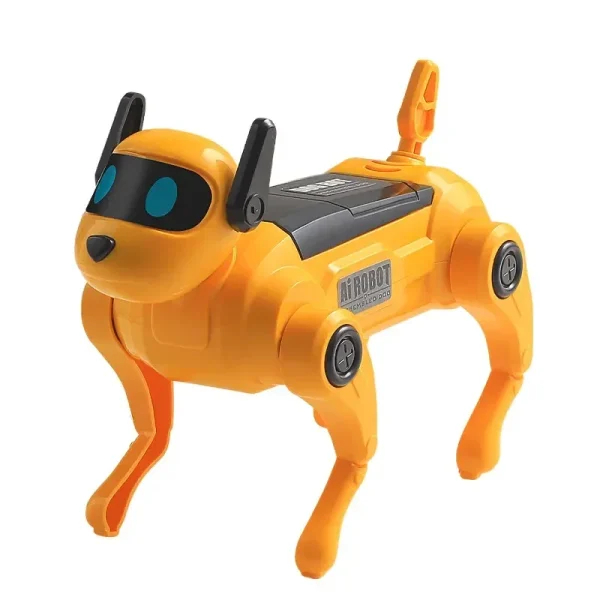
DIY Robot Dog Kit with Voice Control
DIY assembly before you play
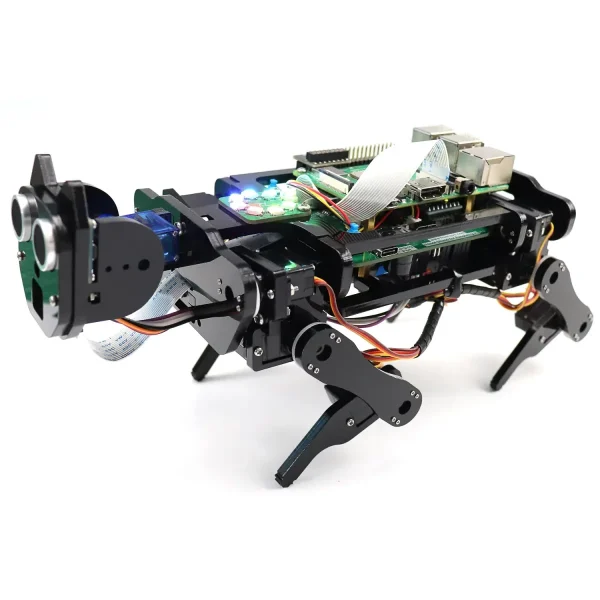
Freenove Robot Dog Kit for Raspberry Pi 5, 4 and Zero 2 W
Four-legged robot dog kit with 13 servos, a camera and an ultrasonic sensor

Walking Plush Robot Puppy That Barks and Wags, 7 in (18 cm)
Walks, barks and wags its tail
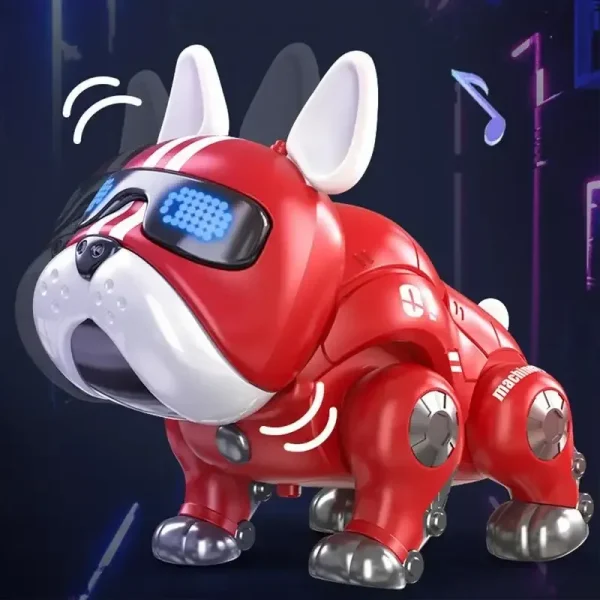
Dancing Bulldog Robot Toy with Music and Lights, Red
Dances and plays music
Delivered prices, import fees paid by our shipping partner.
Sources and fact table
Every number on this page links to a row below: the claim, how strong the evidence is, the source, and when we checked it.
Fact table (37 facts)
| ID | Claim | Evidence | Source | Checked |
|---|---|---|---|---|
| F1 | Contixo R3 Interactive Smart Robot Pet Dog Toy: brand-store price; responds to touch commands and has a remote control; maker's age grading | Supplier-stated | contixo.com | 2026-10-23 |
| F2 | Contixo R3 user manual: batteries, programming mode, voice instructions, sleep timer | Supplier-stated | cdn.shopify.com | 2026-10-23 |
| F3 | Ruko R1 Mini Robot Dog: brand-store price; remote control and gesture sensing; programming up to 10+ actions; playtime | Supplier-stated | ruko.net | 2026-10-23 |
| F4 | Sharper Image Ai Dog Robot: brand-store price; control methods | Supplier-stated | sharperimage.com | 2026-10-23 |
| F5 | Petoi Bittle X V2: starting brand-store price and package range | Supplier-stated | petoi.com | 2026-10-23 |
| F6 | Petoi Bittle X: maker's age guidance | Supplier-stated | petoi.com | 2026-10-23 |
| F7 | Petoi Bittle X V2: joints, coding options, board, sensors | Supplier-stated | guide.petoi.com | 2026-10-23 |
| F8 | Petoi Bittle X: voice commands processed locally | Supplier-stated | petoi.com | 2026-10-23 |
| F9 | Petoi Bittle X: runtime, payload, charger, assembly time, water resistance | Supplier-stated | petoi.com | 2026-10-23 |
| F10 | Petoi battery guide: robot battery spec, runtime by use, charging warning; infrared remote coin battery | Supplier-stated | guide.petoi.com | 2026-10-23 |
| F11 | Petoi OpenCat ESP32 framework: open-source license | Document-verified | github.com | 2026-10-23 |
| F12 | Petoi international orders: shipping and customs | Supplier-stated | petoi.com | 2026-10-23 |
| F13 | Freenove Robot Dog Kit for Raspberry Pi (FNK0050): brand-store price; what is not included; programming; app | Supplier-stated | store.freenove.com | 2026-10-23 |
| F14 | Freenove Robot Dog Kit for ESP32 (FNK0062): brand-store price; what is not included | Supplier-stated | store.freenove.com | 2026-10-23 |
| F15 | Freenove store: customs line | Supplier-stated | store.freenove.com | 2026-10-23 |
| F16 | SunFounder PiDog: brand-store price; Raspberry Pi not included; compatible boards; servos; programming | Supplier-stated | sunfounder.com | 2026-10-23 |
| F17 | SunFounder PiDog documentation: sensors and capabilities; Standard vs V2 | Supplier-stated | docs.sunfounder.com | 2026-10-23 |
| F18 | SunFounder PiDog code: license | Document-verified | github.com | 2026-10-23 |
| F19 | MangDang Mini Pupper 2: brand-store prices; contents | Supplier-stated | mangdang.store | 2026-10-23 |
| F20 | Mini Pupper documentation: lidar needed for ROS SLAM and navigation | Supplier-stated | minipupperdocs.readthedocs.io | 2026-10-23 |
| F21 | Mini Pupper ROS code: license | Document-verified | github.com | 2026-10-23 |
| F22 | Unitree Go2 store prices | Supplier-stated | shop.unitree.com | 2026-10-23 |
| F23 | Unitree Go2 store: shipping and customs | Supplier-stated | shop.unitree.com | 2026-10-23 |
| F24 | Unitree Go2 spec table: size, weight, motors, sensors common to all versions | Supplier-stated | unitree.com | 2026-10-23 |
| F25 | Unitree Go2 spec table: secondary development by version | Supplier-stated | unitree.com | 2026-10-23 |
| F26 | Unitree Go2 spec table: performance by version | Supplier-stated | unitree.com | 2026-10-23 |
| F27 | Unitree Go2 spec table: features that differ by version | Supplier-stated | unitree.com | 2026-10-23 |
| F28 | Unitree Go2 page: 4G coverage footnote and functional limits | Supplier-stated | unitree.com | 2026-10-23 |
| F29 | FCC definition of 'advanced robotic device' (as adopted from the National Security Determination) | Document-verified | fcc.gov | 2026-10-23 |
| F30 | FCC fact sheet, 28 July 2026: effect on existing and new models | Document-verified | docs.fcc.gov | 2026-10-23 |
| F31 | CPSC Small Parts FAQs: ban scope, labeling, how age is judged | Document-verified | cpsc.gov | 2026-10-23 |
| F32 | CPSC Child Safety Protection Act fact sheet (Publication 282): small-parts label for ages 3 to under 6 | Document-verified | cpsc.gov | 2026-10-23 |
| F33 | Australia: mandatory safety standard for products containing button and coin batteries | Document-verified | productsafety.gov.au | 2026-10-23 |
| F34 | Australia: what counts as a button or coin battery; four mandatory standards | Document-verified | productsafety.gov.au | 2026-10-23 |
| F35 | ATO: GST on imported goods at A$1,000 or less vs over A$1,000 | Document-verified | ato.gov.au | 2026-10-23 |
| F37 | Robot Central store delivery and tax policy | Owner-reported | Robot Central policy | 2026-10-23 |
| F38 | Robot Central Frontier policy | Owner-reported | Robot Central policy | 2026-10-23 |
Full source list
Sources
Read on 23 October 2026.
- Contixo R3 product page: contixo.com
- Contixo R3 user manual (PDF): cdn.shopify.com
- Ruko R1 Mini: ruko.net
- Sharper Image Ai Dog Robot: sharperimage.com
- Petoi Bittle X product page and FAQ: petoi.com
- Petoi Bittle X V2 user manual: guide.petoi.com
- Petoi battery guide: guide.petoi.com
- Petoi OpenCat ESP32 repository: github.com
- Freenove Robot Dog Kit for Raspberry Pi (FNK0050): store.freenove.com
- Freenove Robot Dog Kit for ESP32 (FNK0062): store.freenove.com
- SunFounder PiDog product page: sunfounder.com
- SunFounder PiDog documentation: docs.sunfounder.com
- SunFounder PiDog repository: github.com
- MangDang Mini Pupper 2 store page: mangdang.store
- Mini Pupper documentation, features: minipupperdocs.readthedocs.io
- Mini Pupper ROS repository: github.com
- Unitree Go2 spec table: unitree.com
- Unitree Go2 store page: shop.unitree.com
- FCC Covered List FAQ (robots and inverters): https://www.fcc.gov/covered-list-faqs-robots-inverters
- FCC fact sheet, 28 July 2026: https://docs.fcc.gov/public/attachments/DOC-423682A1.txt
- FCC Public Notice DA 26-786: https://docs.fcc.gov/public/attachments/DA-26-786A1.pdf
- CPSC Small Parts and Choking Hazard Labeling FAQs: https://www.cpsc.gov/FAQ/Small-Parts-and-Choking-Hazard-Labeling-FAQs
- CPSC Child Safety Protection Act fact sheet (Publication 282): https://www.cpsc.gov/s3fs-public/282.pdf
- Product Safety Australia, products containing button and coin batteries: https://www.productsafety.gov.au/business/search-mandatory-standards/button-and-coin-batteries-mandatory-standards/products-containing-button-and-coin-batteries-mandatory-safety-standard
- Product Safety Australia, button and coin batteries mandatory standards: https://www.productsafety.gov.au/standards/button-coin-batteries
- ATO, GST on low value imported goods: https://www.ato.gov.au/businesses-and-organisations/international-tax-for-business/gst-on-imported-goods-and-services/gst-on-low-value-imported-goods
- Robot Central delivery and tax policy, and Frontier terms: [policy page URL at publish]
Change log: 23 October 2026: first version; fact-check corrections applied the same day (battery notes, Petoi remote, Go2 programming wording, store and Frontier lines).